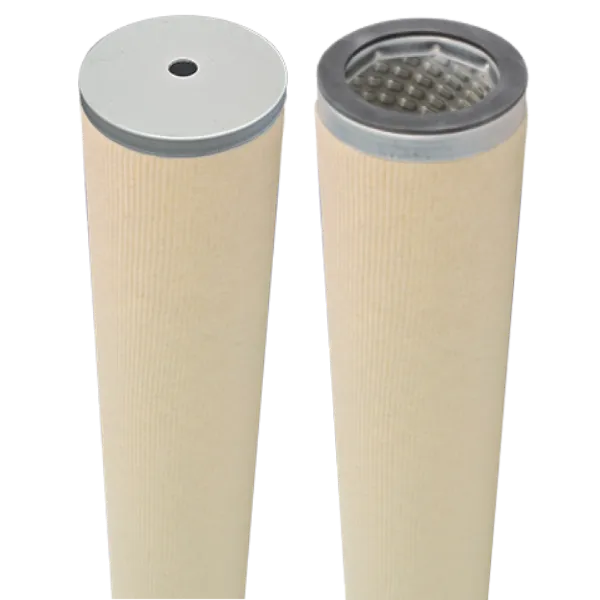
FG (FG)
Key Features
- Industry workhorse phenolic‑impregnated fiberglass depth media
- True gas separator, coalescing & particulate capture
- Lowest lifecycle cost in its class
Overview
Phenolic‑bonded fiberglass depth elements coalesce liquids and capture fine solids with low initial dP, protecting compressors and downstream equipment. A cost‑effective, industry‑standard solution for gas separation across diverse applications.
How It Works
Gas flows outside-to-inside through a cotton-covered fiberglass depth matrix. Particulate loads on the exterior while submicron aerosols impinge within the phenolic-impregnated fibers, coalescing into larger droplets that drain by gravity.
Applications
- •Natural gas transmission, gathering, and metering: fine particulate and aerosol control
- •Plant air and process gases in oil & gas, petrochemical, and industrial service
- •Prefiltration for dehydration (glycol), desulfurization, CO2 removal, and compressor inlet protection
- •Typical contaminants: rust/scale, dust, iron sulfide fines, lube mist, condensable aerosols
FAQs
- •
What contaminants does the FG coalescer remove?
The FG removes rust, scale, dust, iron sulfide fines, lube mist, and condensable aerosols from natural gas, plant air, and process gas streams with 98% efficiency.
- •
What competitor elements does the FG replace?
The FG directly replaces Parker/Peco FibrSep FG, Jonell JFG/JMG, AJR FJC, Filter-Fab MFG/MFS, Royal Filter RF, and Shawndra SPI elements.
- •
What applications use FG coalescers?
FG elements are used for natural gas transmission/gathering/metering, plant air, compressor protection, glycol contactor inlet, dehydration prefiltration, and general gas/aerosol separation.
Physical Specifications
Media Specifications
Housing Compatibility
- Fil-Trek 75H Series
- Parker Series 75/85
Competitor Cross-Reference
- Parker/Peco FibrSep FG
- Jonell JFG/JMG
- AJR FJC
- Filter-Fab MFG/MFS
- Royal Filter RF
- Shawndra Sparksfilters SPI-5000
- Shawndra SPI
Build Your Model Code
FG-___-___-___-___-___FG-336-0.3-V-C-C-SS